
Ask Dr. Lennie
Ask Dr. Lennie features insights from Dr. Lennie Scott-Webber, Ph.D., Marco’s Education Consultant, and a recognized leader in educational design and its research. Drawing on decades of academic and industry experience, she shares practical guidance on how furnishings and spatial decisions influence learning outcomes
Q: We’re redesigning a K–5 school with very traditional classrooms—concrete walls, fluorescent lighting, and windows. We want to “soften” the environment for young learners. What furniture options should we consider?
A: Great question! Before choosing furniture, it’s important to clarify what “softening” means and why it matters. The intention behind the change will guide the best solutions.
If “softening” means offering students more choice in how and where they learn (often called student agency), while also giving educators flexibility to guide instruction and transitions (teacher agency), furnishings can play a powerful role.
Softening a classroom can happen in several ways:
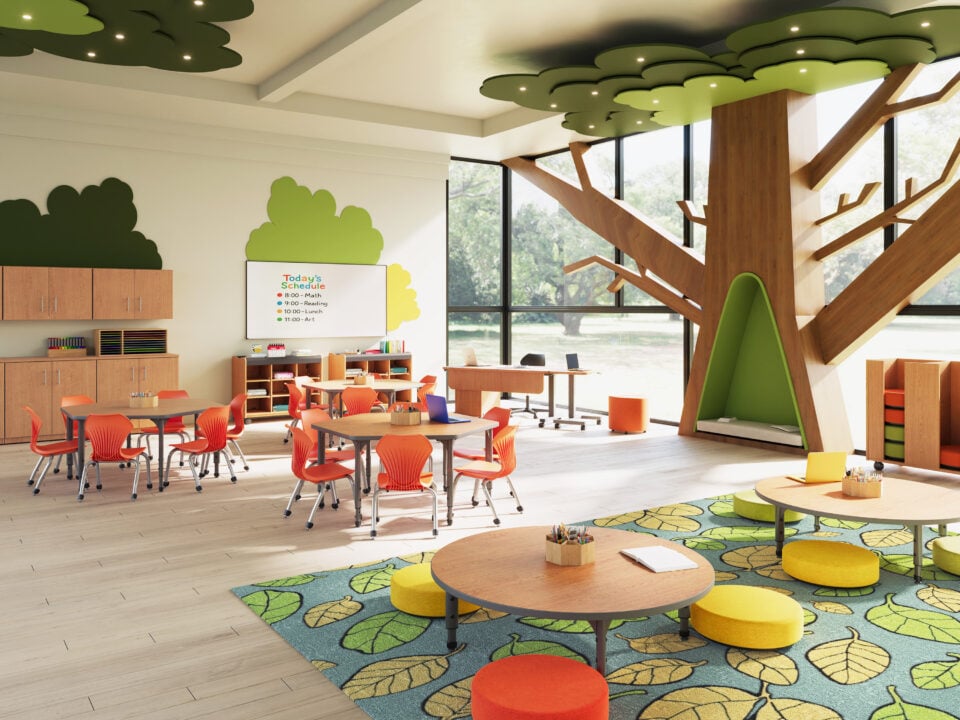
Shape
Curved and organic forms feel more natural and approachable.
Materials & finishes
Warm textures and natural finishes strengthen our connection to nature, supporting biophilic tenants.
Environmental support
Thoughtful lighting and acoustics enhance comfort and support focus.
Research supports these suggestions. A study by Determan et al. found that a biophilic-supported (nature-inspired) environment increased average middle school math scores by 3.3x after design changes.
“Place matters. What surrounds us, shapes us.”
Why Furniture Shape Matters
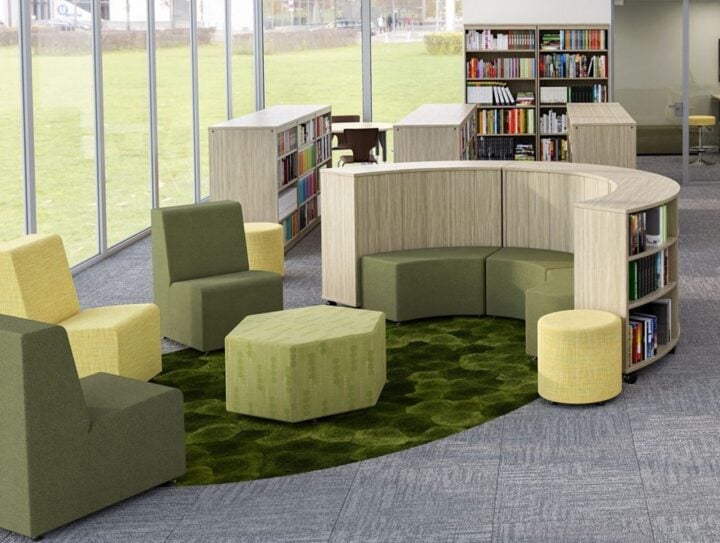
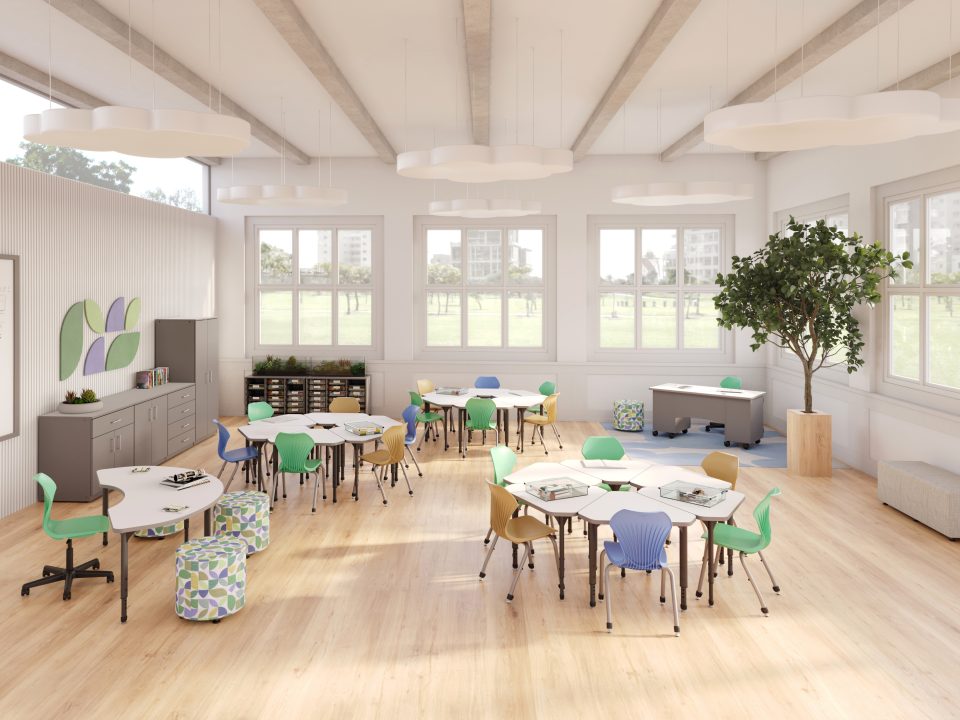
Curved furniture—such as semi-circular desks or rounded tables—mirrors forms found in nature. These shapes tend to feel safer, softer, and easier to navigate, and also support universal design principles – anyone should be able to navigate their built environment. In learning environments, curvilinear forms also encourage eye-to-eye interaction, conversation, and collaboration.
Research published in PNAS suggests that eye contact may be a key mechanism for coordinating shared and independent modes of thought, making curved gathering shapes especially effective for young learners.
Furniture can also help educators “cue” behavior and activities.
For example:
Bringing It All Together
When redesigning K–5 classrooms, consider these steps:
Clarify the educational practice
Understand the culture, teaching style, and learning goals of the school community.
Align language with intention
Dig into what the client really means by terms like “soft,” “flexible,” or “student-centered.”
Choose furnishings that support both physical and psychological comfort
This is a flexible section where you can share anything you want. It could be details or some information about feature two.
More Resources
To explore how shape and design influence learning outcomes, check out additional Marco resources :
Ask Dr. Lennie:
Do you have a question for Dr. Lennie? Feel free to submit your question, and we may use it in a future blog article. You can also reach us by emailing
Address
5400 Doniphan Drive, Neosho, MO 64850.
List of Citations from Ask Dr. Lennie – Marco Blog
OECD. Student Agency
Olsen, B. & McIntosh, J. (2024). What is teacher agency, and how can it improve education around the world?
Commentary: The Brookings Institute. https://www.brookings.edu/articles/what-is-teacher-agency-and-how-can-it-improve-education-around-the-world/
n.a. (n.d.). Commercial Lights
NOTE: classroom horizontal average of 50 foot-candles, measured at desk height. n.a. (n.d.). Commercial Lights.
Determan, J., Akers, M. A., Albright, T., Browning, B., Martin-Dunlop, C., Archibald, P., & Caruolo, V. (2019). The impact of biophilic learning spaces on student success. Retrieved from
n.a. (2024). Center on the Developing Child. Harvard University
NAAVA. (2025). The science behind biophilic design: Why nature improves human connection.
nVinney, C. (2021). 7 principles of universal design to make your X inclusive. CareerFoundry.
Wohitjen, S. & Wheatley, T. (2021). Eye contact marks the rise and fall of shared attention in conversation. PNAS. Psychological and Cognitive Sciences
Terada, Y. (2025). Research-based tips for optimal seating arrangements. Edutopia.
